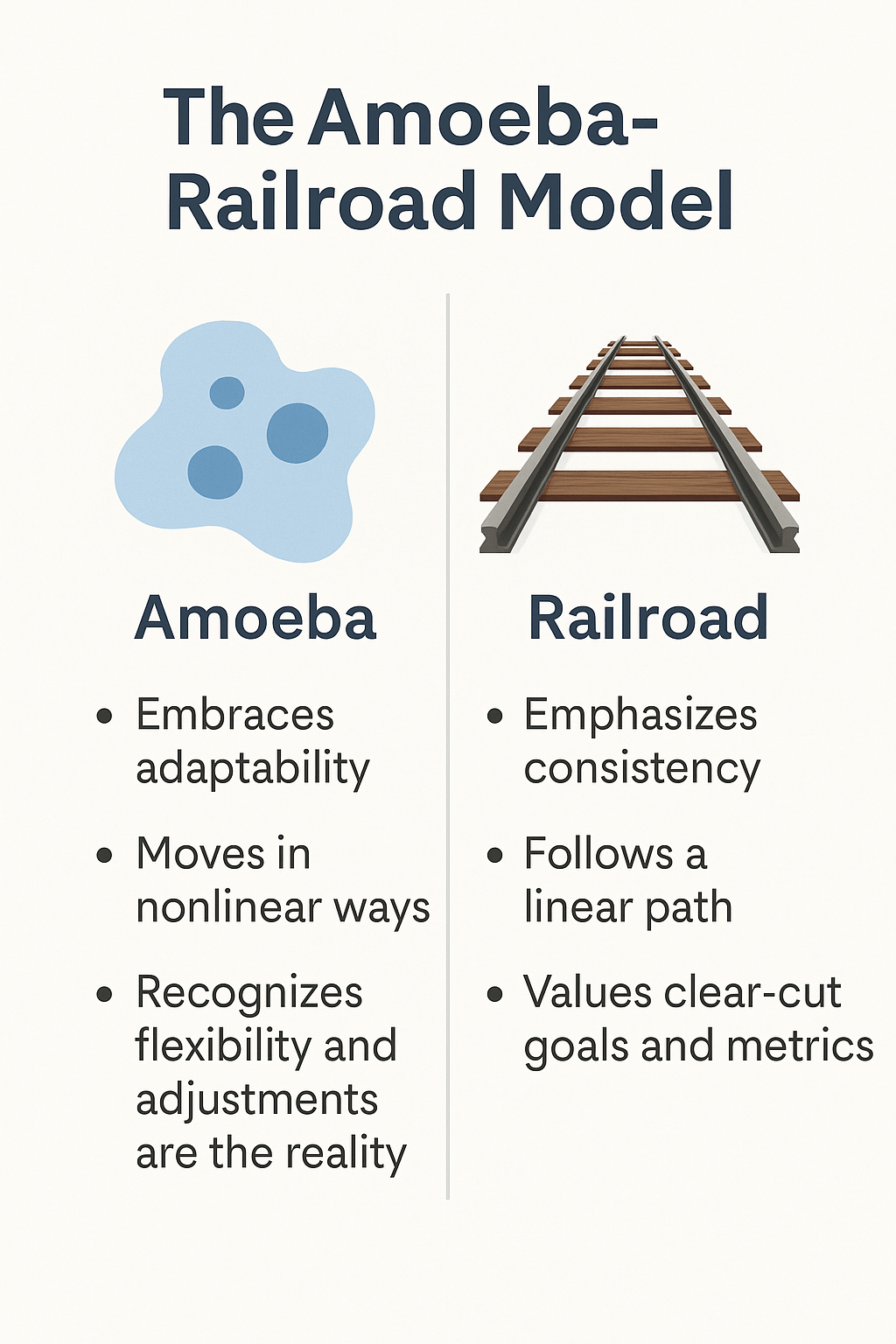
Acting Amoeba and Talking Railroad
by Dr. Jeff Price, Lessons I’m still learning, living and sharing
Way back in Principal School, I had a professor who dropped this line on us in class one day:
“Sometimes, you have to act amoeba but talk railroad.”
How’s that for an opening line? And, as strange as the statement seemed when I first heard it, this ended up being a foundational piece of my leadership mindset.
This professor REALLY knew his stuff and my cohort and I had learned to just go with it, trust the process and wait for the lesson that was about to be dropped. Here’s what he explained.
Learning organizations aren’t rigid machines. Instead they can be more like giant amoebas. These are organic entities that move, shift, and stretch in sometimes unpredictable ways. As the leader, you push this blob to get it moving and some parts race ahead. Others wrap around you or move sideways. To move a school forward, you have to adjust constantly: nudge one part here, slow another there, guide another back on course. You’re monitoring and adjusting constantly, based on the behavior of the system. All the while, you are moving forward in the direction of your goals.
But while this is happening in the day-to-day reality of a school, the district that the school is a part of still needs a clear signal: Are we on track? Are we making progress? And really, so does the school itself. That’s where “talking railroad” comes in. When talking about the day to day work, it’s important to use language that includes crisp goals, defined metrics, and check-ins to show progress and maintain momentum. Think of a railroad track. These are clear cut, linear paths that lead to a specific destination. It’s difficult to move side to side and all the momentum is in one constant direction on a railroad track. The structure helps keep direction and coherence even when the actual daily work is usually something far less than linear. And, by using this language, people can get a clearer picture of the plan AND the intended outcomes for that plan.
The organization has to move and flex organically, decidedly not like a train on a track, to meet the diverse needs of everyone in it. That’s the reality. Schools and districts are human centered things. At the same time, our schools and districts must have clear and consistent monitoring of well defined metrics to check progress on how those humans are doing.
The moral of the story is that it’s not about choosing one over the other. It’s understanding that both are needed simultaneously. We have to build systems that are flexible enough to adapt to the context and still have clear outcomes and checkpoints.
Here’s what our professor wanted us to consider:
- Learning organizations are best when they’re responsive and evolving (Amoeba).
- Clear metrics (railroad) are wildly important, but they’re not enough alone
- Adaptive leadership (amoeba) is where strategy (railroad) meets reality.
- Effective systems understand and honor both.

 Learning to Leading Bridge
Leave a comment