“What we really need here is to get some buy-in from our stakeholders. Once we get that, we’ll know everyone is committed.”
Take a minute and just think about how many times you’ve heard a version of that statement…this week.
Is it really “buy in” we’re after? When I hear, or when I slip and use the phrase, I get the feeling we’re trying to sell a car. “What’s it going to take me to get you into this sweet, sweet automobile?”
So what’s the problem?
Buy in feels one sided and top down or even forceful. If I can just find out the right way to trick you or convince you that you need this thing, you’ll see how great it is and go with it. It implies a lack of shared ownership. So, when things go sideways or they just get difficult, the people that have “bought in” might cut their losses and ditch the idea. That can be overt or can be one of those quiet quitting things.
What we actually need is shared commitment
What resonates with me more than selling an idea is the notion of shared commitment to a common goal or vision or mission. Here, EVERYONE is able to understand, contribute, and make personal and meaningful connections, not just the person with the original idea. The goal isn’t simply awareness, it’s connection. Connection to the heart of the organization. The mission and vision. To each other.
The difference can be glaring when things don’t go well. Let’s compare the two:
Buy in – Sounds like “I told (sold) you on how important and great this was and it’s not happening. Why not?”
It’s top down. It’s extrinsic. It carries pressure to avoid getting in trouble and being punished.
Shared commitment – Sounds like, “We all agreed that this was a key piece of how we will meet our mission statement and you aren’t living that right now.”
It’s collective. It blends intrinsic and extrinsic motivation because the commitment is both personal and to the group. It carries pressure and it’s centered on letting the team or organization down.
What if an initiative really needs to happen?
Now it might seem counterintuitive but, this distinction matters even more when something absolutely needs to happen. Whether it’s on your campus, your district, or in your organization this shift in approach makes all the difference. If there’s a non-negotiable initiative, or an urgent need, you don’t need better marketing or a stronger push for “buy-in.”
You need a shared sense of urgency, collective ownership, and a call to the driving mission.
That is shared commitment. And it’s much stronger than simple agreement, it’s alignment.
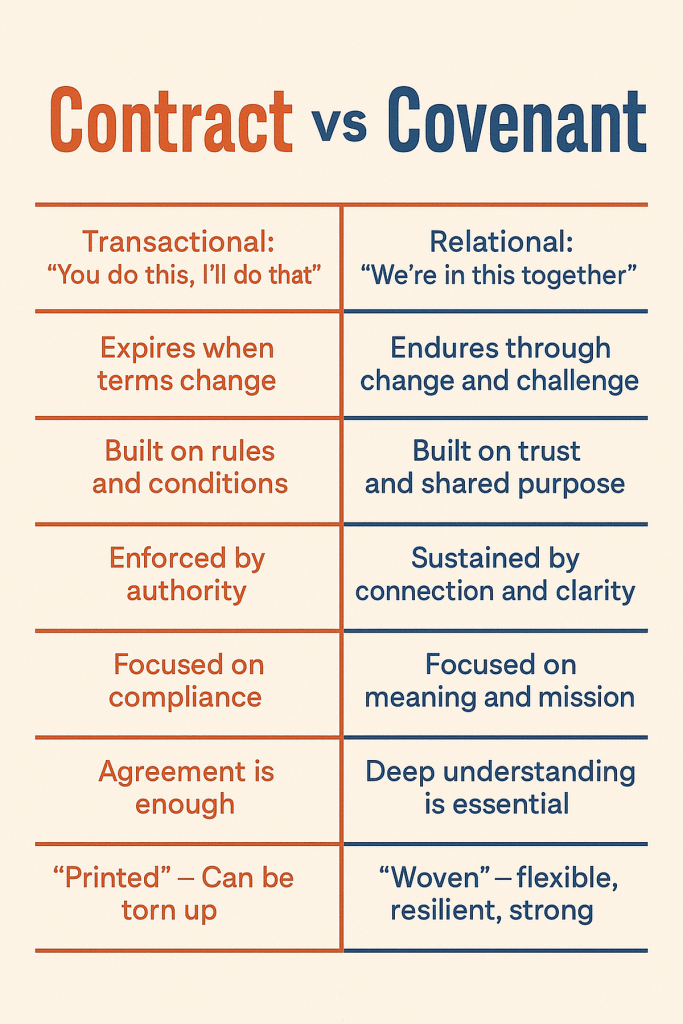
Contract vs Covenant
A closely related concept is the contrast of a contract with a covenant. A contract is written on paper that can be ripped and torn up versus a covenant that is more like a piece of fabric that bends and folds with the changing environment. That fabric is more resilient and much more difficult to tear. Seriously, the pro wrestler move of the shirt rip…a lot harder than it looks on screen.
Rethinking the phrase
If you’re asking for “buy-in,” pause. Ask instead: What would shared commitment look like here? What would it take to make this effort something we all feel connected to, and responsible for?
Buy in gets you agreement, a term contract. Shared commitment offers resilience and a common goal.
Buy in is temporary. Shared commitment is transformational.
So if we’re looking for real change, let’s stop selling and start building something worth belonging to.
 Learning to Leading Bridge
Leave a comment