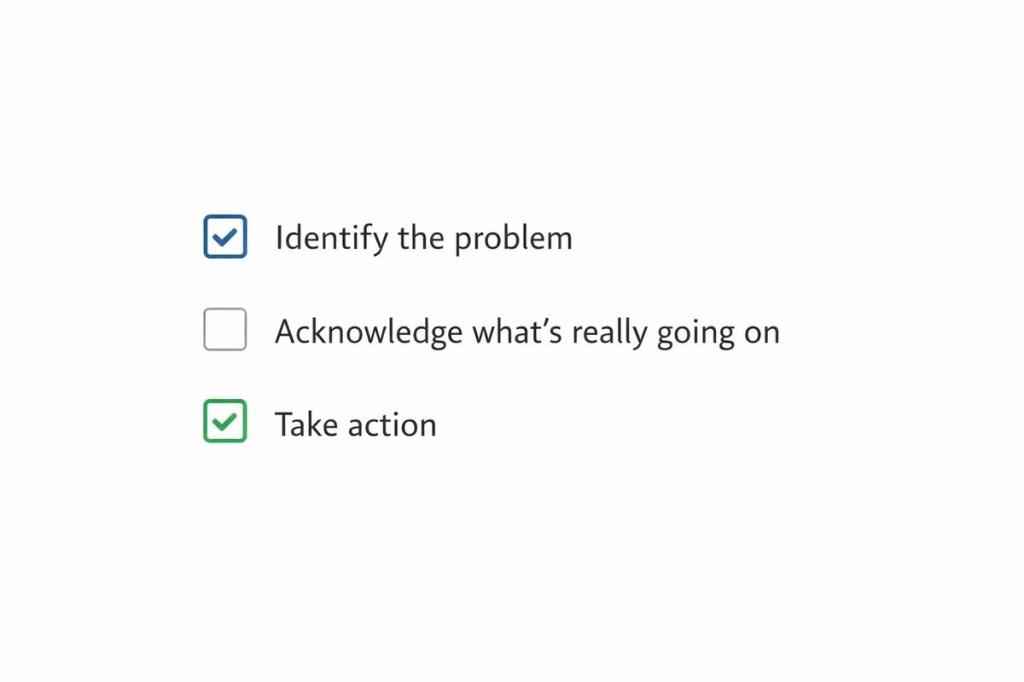
This week a discussion on one of my regular podcast listens jumped out at me. The guest said that the gap between a problem and acknowledging it is usually greater than the gap between that acknowledgment and taking action to address it. It’s more difficult, they said, to accept the reality of a situation than to work to fix the situation.
It struck me as something fundamental that I agreed with in principle but also something I don’t know that I had ever sat with and thought about.
Why was this resonating me?
Digging deeper
First off, I had to recognize I was interpreting the “difficulty” described here as being something internal; feelings, motivations, things like that. Because, in my regular work world I really could just say, there’s the problem and here’s the fix without getting too wrapped up in emotions. Done. Next problem. I acknowledged and got it fixed. I even made a checklist and checked things off as a I did it. What’s so difficult with that?
This is all “fine” and pretty decent leadership, right?
But, why would the idea from the podcast make me stop and wonder? I realized it must come down to what we actually mean by acknowledging a problem. It’s more than simply identifying a problem. Even more, it speaks to the depth of the work actually needed to get to the core issues or causes that are nagging at us. And I remembered what it was like to push myself to go deeper when results were not quite where I wanted or expected them to be. Definitely not an easy thing to do.
So What’s So Hard?
Acknowledging = internal reflection on deeper causes and that’s personal
Identifying and Doing the work = more external and transactional
Going deep on acknowledging can be devastatingly disruptive. Really, questioning what you’re doing while you’re under pressure to get results is insane. Unless you’re serious about actually getting those results.
The work is the work. The daily grind is a grind and it’s still easier to do than reflection for a lot of us.
Identity
When we work in high stress, high stakes roles (who doesn’t these days), we have a finite amount of energy. We need all we can scrape out of ourselves to get the difficult (and rewarding) work done. Pausing to find the deeper root causes of issues inevitably leads us to our own role in the situation. It does, even if you don’t want to talk about it right now. And doing that? It can lead us to question who we are. If we identify as the person who can fix things, get things done, always knows the right answer…what happens when we find out we aren’t fixing things let alone getting them done. And these right answers are only getting partial credit. That can put you in a tailspin.
Avoiding the self reflection and keeping a deep dive of problems shallow lets you get right to planing the work and working the plan, starting that journey of a thousand steps with the first step knowing the best way out is through. Action action action.
Or you’re just spinning your wheels.
Gaining Traction
If you haven’t done the work acknowledgment takes you just spin in place. Yes, you may make some gains but you might not know exactly why things worked out. You got lucky, and lucky and sustainability rarely hang out together long term. And you may just dig yourself in deeper in the process.
It’s worth the internal stress to go deep and be uncomfortable, though. Acknowledging the deeper issues, the root causes is simple but certainly not easy. And if you think you should be doing something, keep in mind you are. You’re going to make the plans and you’re going to look for systemic solutions and these will both be on more solid ground.
But making the effort to do the difficult deeper dive, including your own role in things, takes time. There are reasons the process stretches the distance between acknowledging to truly targeted action.
And just as many reasons why that’s so important.
How do you know you’ve acknowledged the right problem recently?
Did some perceived efficiency get in the way of success?
 Learning to Leading Bridge
Leave a comment