Being Strategic About Our Planning
Long-term, visionary planning has been, and will continue to be a constant topic of discussion and focus for leaders. Vision and mission are rightfully at the heart of long term planning processes. But all the planning doesn’t matter if it isn’t directly connected to action based on those plans. But where do you start in the process, short term or long term goals? Should our plans stress a long term ideal that plays out over years? Or, should our plans target quick, short term goals that will either be made or missed by the end of the current school year. To start, consider these 2 scenarios about planning:
Scenario 1 – I just watched a video about the best idea ever. It’s so cool and we can use it right away. You don’t even have to learn anything new really. And it’s pretty inexpensive. I think the whole team is going to love it. We’re guaranteed to get results so fast. All our stakeholders will love to see our quick progress.
Scenario 2 – I just watched a video about the best idea ever. We should use the upcoming district retreat to try out this planning model that will have us come up with some plans for some goals we might be able to achieve in the next 2 or 3 years. We can get everyone’s input. Our stakeholders will love to see our long term focus and where we see ourselves as we grow in the next few years.
Either of those sound familiar? Each one of those might be something you’ve said to your team or heard someone say to you. Scenario 1 is a rapid response to issues that are front of mind. Maybe it’s a concern we just saw this week on our campus or district. Scenario 2 addresses an aspirational goal and is really a model for planning and brainstorming. So which one is the way to start? Is that your final answer?
My response? Yeah, how about neither…or both. What a wishy washy answer, right? Stick with me.
Balancing the work of Today with the work of Tomorrow
The Short Term Fix vs The Long Term Dream
What if you or your organization, campus, or district is facing some very real and difficult IMMEDIATE short term hurdles, walls, or cliffs? You have to have results now, not in 2 or 3 years. And in the face of these pressures there is a lot riding on getting things moving quickly on the ground. We might be tempted to tell ourselves that we shouldn’t lose time to the detached daydreaming that scenario 2 might lead us into. Yes, absolutely. But, at the same time we have to ask, how do we avoid a series of quick fixes? Fixes that might, if we’re lucky, connect to other initiatives we’ve raced to implement. There is still an empirical need to have a long term road map in place. A plan that looks 2 or even 3 years down the road. Scenario 2 nudges us towards this.
You have to start somewhere but where is that exactly? Recently I heard someone put this conundrum into a great phrase. You have to work on the work of today without losing sight of the work of tomorrow. Let’s think about it.
The Ideal – And What if Things Work Out Perfectly?
Let’s be real, as much as the immediacy and urgency of daily work demands, you do absolutely have to start with a vision of where you want to be. And I mean a perfect world vision of that ideal goal. I want you to imagine a genie lands on your desk and gives you a wish without any kind of catch. This is a straight up, “What do you really want” type wish you’ve been granted. Dream big. Take the time to really go deep with this one too. What is it you want? What does that look like? What does it sound like? What does it feel like? This is NOT time for any hints of doubt or “oh, that will never happen” talk – even jokingly. What. Do. You. Wish. It. Could. Be. Ask yourself one of the most powerful questions that can be asked, “What if everything works out?”
Once you have this ideal vision, you’ll have your North Star that you will navigate by, your fixed compass direction, your coordinates that a long sleeping droid just dropped on you in a massive space map reveal. Fyi, not sorry for the nerdy Star Wars reference there. This is your vision. This is where you want to be when your work over the next 2 or 3 years has paid off. Everything that is next will be based on this ideal state.
How close are you to that vision? How do you know?
Next, we have to ask, how close are we to this ideal? No, really. How close are you really, as a person, a classroom, a campus, an organization to reaching it? And, just as importantly, how do you know? Let’s take a minute and think about two different types of “knowing” how things are going in an organization. There are 2 big types of truth to consider, the Stated Truth and the Ground Truth. And they are not the same.
Stated Truth
This is exactly what it sounds like. It’s what we tell ourselves and others when discussing how the organization is doing or where things are headed. This “truth” might be sort of true but no one is worried about verifying. Is it the actual truth, though? Maybe. One method that is used to justify these “stated truths” are Cardiac Assessments.
Cardiac Assessments
The most straightforward way to think about Cardiac Assessments is the phrase “In my heart of hearts, I KNOW this is true.” I can just feel that it’s working and I’m sure that everyone is putting their best foot forward. When heard this way, the phrase can sound pretty silly in the context of complicated systems like schools. Think about being asked if a group of students attained mastery of a concept and your response was to shrug and say, “Yeah, I haven’t really looked at their work yet, but I’m sure they all got it. I feel pretty good about things.” Red. Flag.
I should pause here and say that this is not the time to become pedantic and sing the praises of “gut reactions.” Yes, there is often a real reason for our immediate reactions to certain situations and those reactions can certainly be valid. But to not follow up and investigate and unpack those feelings can be unwise and a missed opportunity for more information gathering and verifying. Here, I am talking about your final Jeopardy answer being based solely on how you feel something is or isn’t working.
Ground Truth
A deeper level of understanding comes from seeking the Ground Truth. Here, we are looking for the actual current reality by gathering and analyzing multiple data points. This includes all kinds of data: quantitative (results, actual numbers) and qualitative (interviews, surveys, focus groups). This information is gathered literally from the ground up where the actual work is being done by the actual practitioners. While we can say things are a certain way and that we feel good or bad about a situation, we won’t really know what is really happening until we look and unpack what we find.
Stated vs. Ground truth:

Big Ideas Before Specific Actions
“A goal without a plan is just a wish”
-de Saint-Exupery
Knowing where you want to go and doing nothing about it is surely one of those definitions for insanity. If it isn’t, it absolutely is a definition of ineffectiveness. It’s time in the planning process to take action to meet our lofty vision. But, to avoid racing down the wrong path or racing down several wrong paths, we must prioritize our energies on a handful of key big picture items that must be addressed if we are to meet our vision. Our Scenario 1 from the beginning could potentially be a tempting path at this point. We still need to make some sense of our ground truth and find some context for our actions.
Based on reflections and take-aways from your ground truth analysis process, identify 3 or 4 general areas that need some attention in order for that perfect world to get a little closer to becoming reality. Avoid specific actions for the moment. Stay focused on broad topics.
Here are some examples of specific actions turned into broader perspectives:
Figure 1: Shifting from Actions to Big-Picture Thinking – Reframing tactical tasks as strategic perspectives:
| Instead of starting here: | Start here instead: |
| Specific Actions | Broader Perspective |
| A particular style of professional learning community/planning structures | How do we all plan collectively and collaboratively? |
| A specific walk through form | What classroom information would tell us if we are on track? |
| Lesson Plan templates | How are our teachers mapping out their students’ learning paths? |
| A set number of weekly mandated classroom walkthroughs by campus administrators | How are we ensuring campus administrators are in classrooms and providing feedback for teachers? |
| One to One Mentors for Students | How do we support our kids academically and socially? |
You might be saying, “What, we don’t care about specifics?! See? This is why these long term vision things are just a bunch of daydreams”. Or you might be hearing those phrases pop into your own thoughts as you watch other people’s reactions to this activity. We do care about specifics and those are coming very soon in this process.
Like the phrase from those old commercials…but wait, there’s more! By slowing down and adding this step to the process we are able to create these broad topics that will allow some flexibility in dialing in our specific actions in the future. This is in some ways the missing link in the work of today and the work of tomorrow.
Let’s take a look at the full improvement cycle through the lens of today’s actions and tomorrow’s goals:
Figure 2: The Improvement Cycle – Bridging Today’s Work and Tomorrow’s Vision:

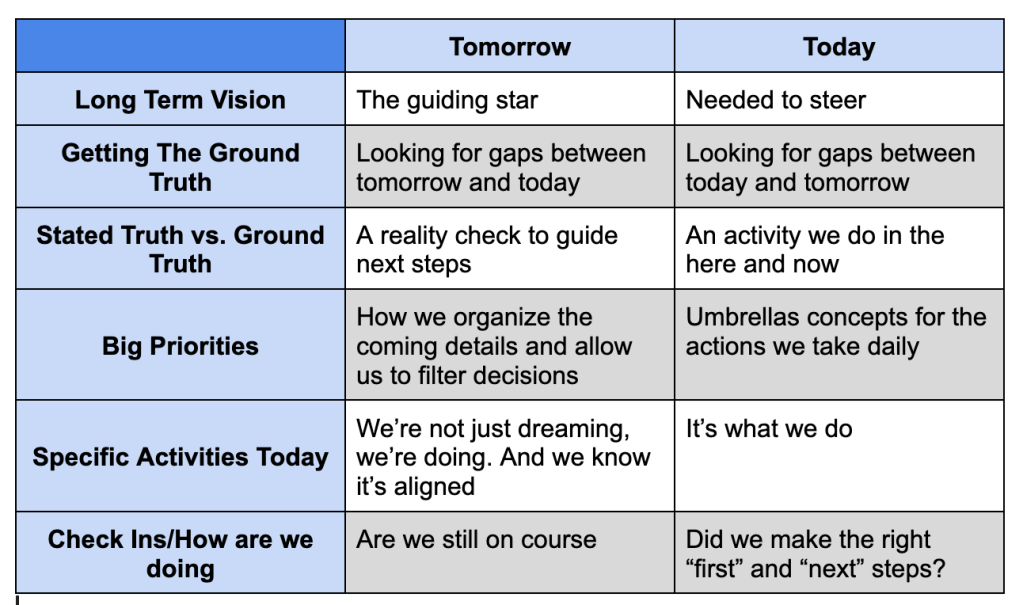
Each step in the cycle has implications for the right now work of today and the longer term work of tomorrow. The table below unpacks this and gives some suggestions:
Figure 3: Strategic Elements Seen Through Two Lenses – Today and Tomorrow:
Now that we have some context and perspective, we can start to analyze and reflect on what specific things we might want to do now. We’re almost ready to ask, “What will this look like on Monday when we start?”
Wouldn’t it be cool if you knew what to say yes to?
So now what? You slowed down. You have this grand vision in front of you. You worked out some big levers you need to push/pull/wiggle/finagle. You might feel great about where you are going. Or could it be that the ground truth showed you just how far away you might be from your perfect state. Maybe it’s a less great feeling. Either way, it’s time to narrow the focus and start working on the details. To my “action first” people, it’s your time to shine! Most importantly, it’s time to shine with clarity around where to start…and what to avoid.
Remember that great thing we come across that seems like such a great idea, you know, Scenario 1? Without any idea of where the organization is headed, how would you know if it was the right thing at the right time?
With the vision, and those big levers identified, you have filters to pass that idea through and gauge how it might work. That vision is your new filter for what does and does not get done.
Standard questions to ask: Does this move our organization toward our long term vision? Which of the big priorities we identified to get us there does this new project fit under? How do you know?
If it does, great! If not, ditch it. Move on. Either way, keeping or ditching, you and everyone in the organization knows the WHY behind the response.
Am I saying quick fixes are wrong?
Not always. I’m also not saying, “No!” should be the new standard answer. And I’m certainly not saying that quick adjustments and short term wins are bad things. I am saying that now, all your “Yeses” about potential actions, both long and short term, will be better aligned, and moving the organization in the same direction toward that ideal vision. Here’s a bonus: With this clarity, everyone in the organization has a better understanding of the types of things they should bring to the table as possible things to do. It allows them to prescreen requests by asking themselves, “Is what I’m about to ask for aligned to the vision? And, is what I want to do or purchase aligned to at least one of those 3 or 4 big concepts we said would get us to our ultimate vision?” This is where everyone’s energy needs to be: aligned and focused on today and tomorrow.
So, what are your right first steps? And then what are the right next steps?
Right next steps and… hermit crabs
Right next steps can be tricky, daunting, and may be uncomfortable if not just plain scary. It’s time for a nature story. Hermit crabs have great houses (those shells) that they get to walk around in. The shells protect them with that hard exterior and give them a place to hide out and lay low tricking people into thinking that they’re just pretty shells to collect. But, as they grow, those hermit crabs have to give up their known and familiar shells to find a new one that is a better and more appropriate fit. Further, as much as a crab might want to move into the biggest and fanciest shell right away, they must find the right size for the next stage of their growth. A shell that’s too big is no better than one that they were squeezed out of. Even though their sights are set on that massive shell they pictured in their minds, they have to find one that’s just a little bigger than the last one. They have to find that next right step. You see where I’m going with this, right?
Figure 4: Right-Sized Growth – The Hermit Crab Approach to Change

Out of the water and back to our discussion about work, you will have your sights set on that massive goal and your right next step might feel a bit too small. But,this is where your energy needs to be. What is the right size of our next step? How does it move us down the path? How does it create or keep our momentum going? If we get caught up in chasing the next cool thing, the “one big thing they don’t want you to know about” we might be going somewhere, but it probably isn’t where we need to be going.
It’s time to ask the question, What does all this look like on Monday when we start the day to day work. This is the quintessential “Work of Today.”
It’s the same picture
So, what’s the right answer? Is it The Work of Today or The Work of Tomorrow?
Yes.
That’s it, my honest albeit annoying answer. It’s one and the same. It’s two sides of the same coin. What we do today is aligned to where we want to go. The work of tomorrow is built on the foundations of decisions and actions taken today. Let’s think about those 2 scenarios we started with. Let’s consider a 3rd scenario:
Scenario 3
I just read about the coolest thing on Reddit. It’s something that will get us results right away and it’s so in line with our long term goals it’s going to be quick to implement. It’s great. We’ll get some early results that we can take a look at that will help us figure out what we need to do next semester.
Here’s a visual representation of how the pieces—vision, ground truth, priorities, and actions—come together in a strategic planning process that honors both pace and purpose:
Figure 5: The Strategic Planning Process – Where Vision and Action Meet

So…What Happens on Monday?
Strategic planning is just what it sounds like – Strategic. It includes long term visions and goals that can sometimes take 3 or 4 years to achieve. At the same time, it relies on balancing those long term goals with shorter and more immediate goals that are directly aligned, some might say strategically, to those long term ideals. For planning to be successful, both short AND long term, there has to be a balanced give and take between the two.
With these insights, what is your right next step to find the balance between the work of today with the vision of tomorrow? That next step doesn’t have to be huge. But it does need to be aligned. So… what will you do on Monday?
 Learning to Leading Bridge